 Twitter


To attain excellence in Ayurvedic Toxicology and Forensic Medicine by strengthening classical foundations, enhancing clinical understanding, and fostering medico-legal competence.

About the department
The Department of Agada Tantra is a specialized branch of Ayurveda dealing with toxicology and medico-legal aspects of medical practice. The department imparts systematic knowledge of Visha (poisons), their classification, properties, symptomatology, diagnosis, management principles, and preventive measures as described in classical texts, along with integration of modern forensic science concepts.
In addition, the department emphasizes medico-legal responsibilities of a physician, professional ethics, legal procedures, and documentation. It prepares students to understand toxicological conditions and medico-legal frameworks essential for responsible clinical practice.


-
To provide in-depth and systematic knowledge of poisons and their therapeutic management.
-
To enhance analytical and practical skills in understanding toxicological conditions.
-
To cultivate strong medico-legal awareness along with professional ethics and responsibility.
-
To encourage academic growth and research initiatives in the field of Agada Tantra.
Academic Strengths
- Strong foundation in classical Agada Tantra principles
- Integration of Ayurvedic toxicology with modern forensic science
- Practical exposure to medico-legal systems and procedures
- Case-based and clinically oriented teaching
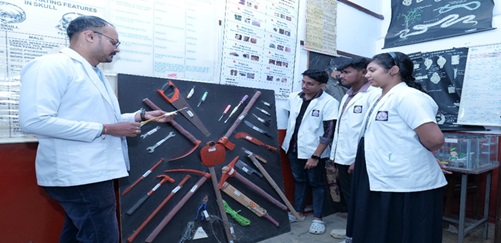
Academic & Practical Training
Core Academic Areas:
- Detailed study of the classification and characteristics of Visha – Sthavara, Jangama, and Kritrima
- Understanding of Samanya and Vishishta Lakshanas of various poisoning conditions
- Fundamental principles and approaches of Visha Chikitsa
- Study of snake bite and envenomation
- Concepts of food toxicity, adulteration and environmental hazards
- Medico-legal assessment of injuries
- Medical jurisprudence and ethical principles in practice
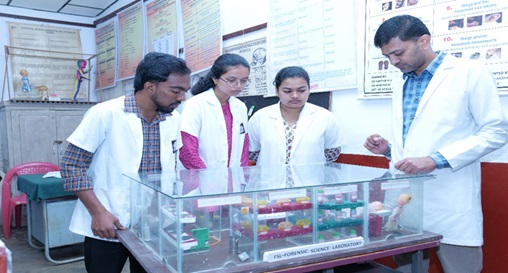
Practical Exposure:
- Identification and demonstration of poisonous plants and toxic substances
- Demonstration of first-aid measures in poisoning cases
- Training in medico-legal documentation and report preparation
- Clinical exposure to medico-legal cases in hospital settings
- Court visits to observe judicial proceedings
- Police station visits to understand medico-legal case procedures
- Educational visits to forensic science laboratories
Teaching–Learning Practices
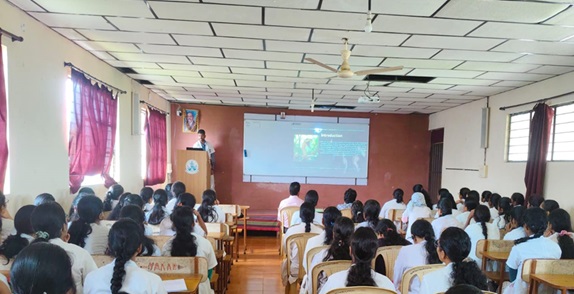
- Interactive and technology-enabled classroom teaching
- Research focusing on standardization, safety, and efficacy of Ayurvedic formulations
- Toxicology museum specimen demonstrations
- Case-based and scenario-oriented discussions
- Tutorials and group learning sessions
- Practical demonstrations and skill-based training
Academic Enrichment Activities
The department actively conducts and participates in:
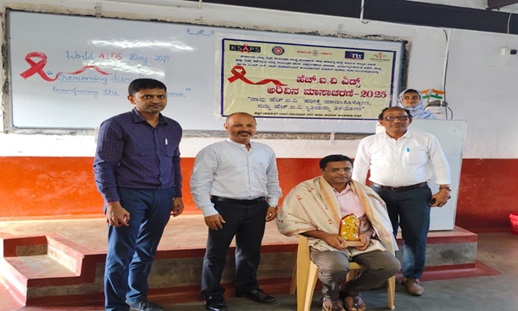
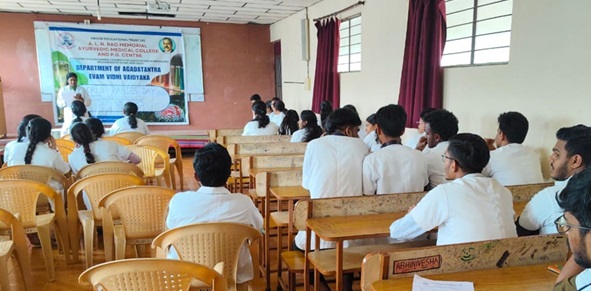
- World AIDS Day Awareness Programme
- Medico-legal Documentation Workshops
- Court Visits for judicial procedure understanding
- Police Station Visits for medico-legal case exposure
- Student seminars and academic presentations
- Health awareness and outreach programmes
Infrastructure & Learning Resources
- Toxicology museum with specimens and charts
- Audio-visual teaching aids
- Medico-legal documentation formats and training support
- Emergency management demonstration models
Research & Innovation
- Conceptual research in Agada Tantra
- Research on traditional Agada Yogas
- Validation studies of classical toxicology principles
- Student research projects and seminar presentations
- Participation in conferences and academic publications
Outreach & Community Services
- Public education on food adulteration and safety
- Observance of important health days including World AIDS Day
